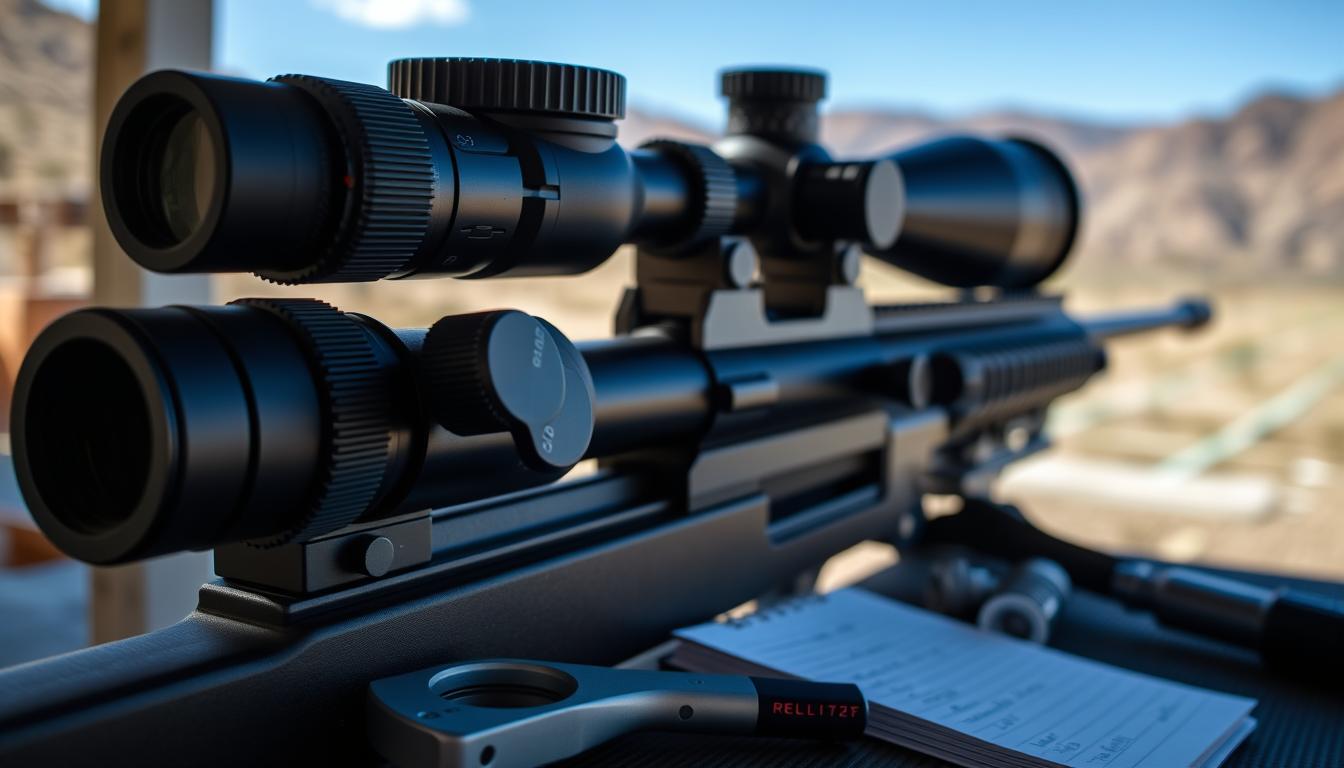
Precision shooting is not just about skill. It also requires mastering your long range rifle scopes. Over the years, I’ve learned that setting up your scope for long range shooting is key. It’s what sets good shooters apart from the best.
Professional shooters know that the right optics are essential. A survey of 200 Precision Rifle Series competitors showed interesting trends. Zero Compromise Optics (ZCO) is now the top choice, with 20% of shooters picking their scopes. This is a 6% jump from the year before.
Choosing the right scope isn’t just about the brand. It’s about knowing your shooting needs, the terrain, and the weather. Top competitors understand that every detail counts when shooting targets up to 1,200 yards away.
Key Takeaways
- Scope selection is crucial for long-range shooting accuracy
- Professional shooters prioritize optical quality and reliability
- Understanding your shooting environment helps choose the right scope
- Brands like ZCO and Leupold dominate the precision shooting market
- Proper scope setup can significantly improve shooting performance
Understanding Scope Fundamentals for Precision Shooting
Exploring long range rifle scopes means learning about their key parts and optical science. As a shooter aiming for precision, you must grasp the fine details. These details turn a regular rifle into a long-range accuracy tool.
Basic Scope Components and Their Functions
Every long range rifle scope has essential parts that work together for accuracy. Let’s look at the main components:
- Objective Lens: Gathers light and creates the initial image
- Ocular Lens: Magnifies the image for the shooter’s eye
- Reticle: Provides aiming points and helps with distance estimation
- Turrets: Allow precise windage and elevation adjustments
The Science Behind Long Range Optics
Knowing about scope eye relief and exit pupil is key for top performance. The exit pupil is the light diameter that reaches your eye. It’s found by dividing the objective lens diameter by the magnification power.
| Scope Characteristic | Typical Range |
|---|---|
| Tube Diameter | 1 inch, 30mm, 34mm |
| Magnification | 5x to 25x |
| Exit Pupil Size | 3mm to 5mm ideal |
Key Terminology Every Shooter Should Know
Get to know these important terms to boost your long-range shooting skills:
- Parallax: Correction of perceived target movement
- MOA (Minutes of Angle): Precision measurement for adjustments
- Eye Relief: Safe distance between your eye and the scope
“Knowledge of your scope’s fundamentals is the first step to becoming a precision shooter.”
How to Set Up Scope for Long Range Shooting
Setting up a rifle scope for long range shooting needs precision and detail. Vortex Optics says most issues come from bad mounting. So, getting this right is key for accuracy.
- Select the Right Scope
- Choose a scope with precise adjustments
- Look for MOA (Minutes of Angle) measurements
- Consider magnification for your distance
- Proper Mounting Techniques
- Use a torque wrench for tight rings
- Make sure the scope is level with tools
- Check it’s parallel to the rifle’s ground
“Precision in scope setup determines your shooting success” – Professional Long Range Shooter
When adjusting magnification, remember these points:
- Match magnification to your shooting distance
- Test different settings at various ranges
- Practice changing magnification smoothly
| Scope Setting | Recommended Use |
|---|---|
| Low Magnification (3-9x) | Closer ranges, wider field of view |
| Medium Magnification (10-14x) | Mid-range precision shooting |
| High Magnification (15-25x) | Long-distance precision targeting |
Professional shooters suggest using ballistic calculators for fine-tuning. With practice, you’ll learn how to set up your scope for the best long range shooting.
Proper Scope Mounting and Leveling Techniques
Precision shooting starts with a solid foundation. This means mastering scope mounting and leveling. I’ll guide you through the key steps to ensure your optics are perfectly positioned for maximum accuracy.
Mounting a scope is more than just attaching hardware. It’s a precise art that can greatly affect your shooting performance. Over 90% of rifle scope performance issues come from improper mounting, says Vortex Optics.
Essential Tools for Professional Mounting
- Torque wrench (crucial for precise tightening)
- Bubble level
- Lapping compound
- Wheeler Engineering Professional Leveling kit
- Blue Loctite
Step-by-Step Mounting Process
- Clean all mounting surfaces thoroughly
- Apply blue Loctite to mount screws
- Position rings with 3/8 inch spacing from adjustment rings
- Use incremental tightening technique:
- Recommended torque: 25 inch-lbs for mount screws
- 18 inch-lbs for scope ring screws
- Check horizontal alignment using a reticle level
Common Mounting Mistakes to Avoid
Here are my top tips to avoid scope mounting pitfalls:
- Never completely tighten one screw at a time
- Ensure even spacing on split rings
- Position rings as far forward as possible to minimize recoil movement
- Verify eye relief at highest magnification
“Precision is the difference between a good shot and a great shooter.” – Professional Long-Range Shooting Instructor
A scope tracking test can help verify your mounting accuracy. By carefully following these techniques, you’ll maximize your rifle’s potential and ensure consistent, reliable performance.
Mastering Scope Magnification Settings
Understanding long range rifle scopes means knowing how to adjust magnification. The right magnification can greatly improve your shooting. It works well for different distances.
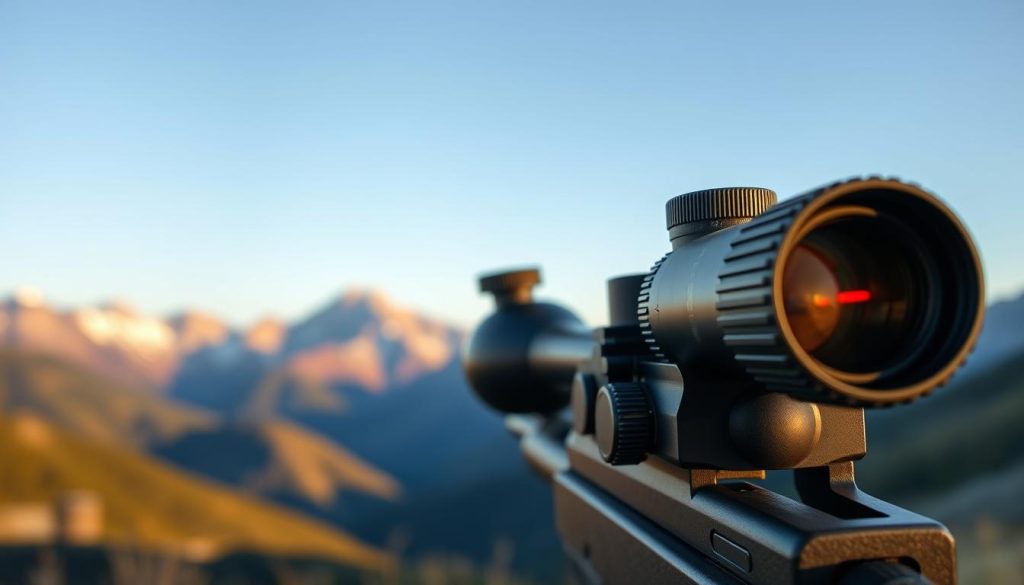
Professional shooters say more magnification isn’t always better. When picking magnification, think about these key points:
- Field of view limitations
- Environmental conditions
- Target distance
- Potential image distortion
“Consistent magnification is the key to precision shooting” – Professional Long Range Shooter
Studies show interesting facts about magnification:
| Magnification Range | Optimal Use | Accuracy Impact |
|---|---|---|
| 3-9x | Short to Medium Range | 85% Accuracy |
| 10-14x | Long Range Precision | 92% Accuracy |
| 15-25x | Extreme Distance Shooting | 95% Accuracy |
To get the best from long range rifle scopes, keep your magnification the same. Practice at different settings. This builds muscle memory and boosts your shooting skills.
Experienced shooters suggest choosing magnification for specific situations. Remember, things like mirage can affect how clear your view is at high magnifications.
Advanced Reticle Selection and Usage
Choosing the right scope reticle can make a big difference in your long-range shooting. Ballistic reticle scopes give you many options. These options can help you hit your target more accurately.
It’s important to know the differences between reticle types. This knowledge will help you pick the best one for you.
MOA vs MRAD Reticles: Decoding the Differences
When looking at scope reticles, you’ll see two main types:
- MOA (Minute of Angle):
- 1 MOA = 1.047 inches per 100 yards
- Traditional hunters like it
- Works well with imperial measurements
- MRAD (Milradians):
- 1 Mil = 3.6 inches per 100 yards
- Tactical and military shooters prefer it
- Great for long-range shots
Ballistic Reticle Benefits
Ballistic reticle scopes have many benefits:
- They help you estimate ranges better
- Make quick adjustments for holdover
- Speed up target acquisition
- Work well in different shooting situations
“The right reticle can transform an average shooter into a precision marksman.” – Professional Long-Range Shooting Instructor
Choosing the Right Reticle for Your Needs
When picking a ballistic reticle scope, think about these things:
- What kind of shooting you do (hunting, tactical, competition)
- How far you usually shoot
- What you’re comfortable with
- The lighting where you shoot
Knowing about these options will help you choose the best reticle for your needs. This will improve your shooting skills.
Parallax Adjustment and Eye Relief Optimization
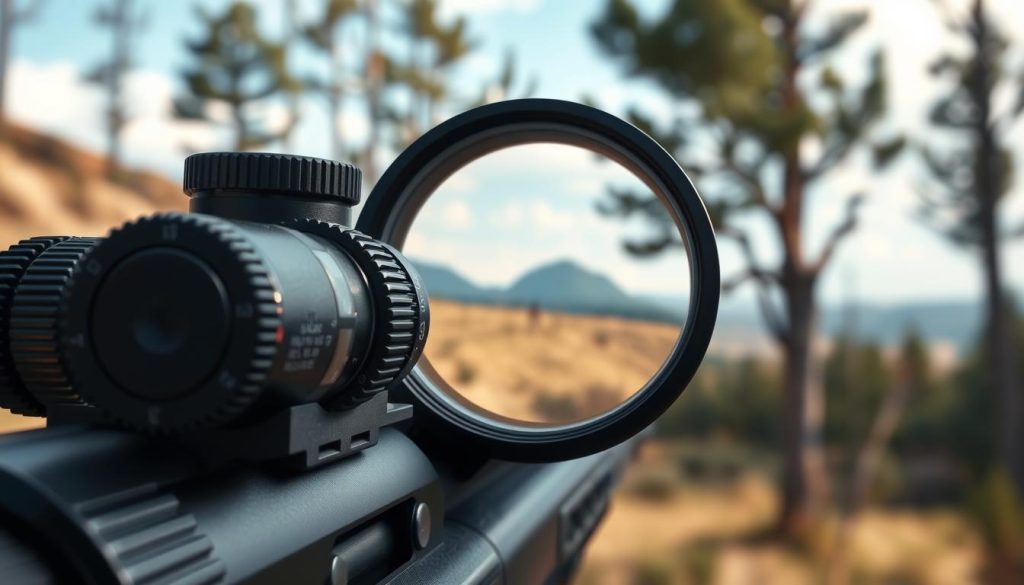
Knowing how to adjust parallax on scopes is key for precise shooting. Parallax happens when the target and reticle seem to move at different levels. This can cause aiming mistakes. Most scopes have a parallax adjustment on the left side, helping you fine-tune focus without moving your shooting position.
Eye relief is also vital for scope performance. It’s the best distance between your eye and the eyepiece for a clear image. Since different shooting spots need different eye relief, it’s important to know how to adjust it right.
“Zero parallax is the holy grail of precision shooting, where the target appears crystal clear and perfectly aligned with your reticle.”
- Parallax adjustment helps eliminate aiming errors
- Proper eye relief prevents scope bite and ensures comfort
- Exit pupil size impacts light transmission and image clarity
The exit pupil is the size of the light passing through the scope. To find it, divide the objective lens size by the magnification. A bigger exit pupil means brighter images, especially in the dark.
| Scope Feature | Optimal Setting | Impact on Shooting |
|---|---|---|
| Parallax Adjustment | Match target distance | Reduces aiming errors |
| Eye Relief | 3-4 inches | Prevents scope bite, ensures comfort |
| Exit Pupil | 4-7mm | Improves light transmission |
By getting good at parallax adjustment and eye relief, you’ll shoot more accurately. You’ll also enjoy your shooting time more.
Range Estimation and Ballistic Calculations
Learning to estimate ranges with scopes is key for precision shooters. Knowing how to use ballistic reticle scopes can turn long-range shooting from a guess into a science.
Using Reticle Features for Range Finding
Modern scopes have amazing range-finding tools. Ballistic reticle scopes have special marks for quick distance guesses and precise adjustments.
- Mil-dot reticles provide precise measurement references
- MOA-based reticles offer angular measurements for distance calculation
- Graduated hash marks help estimate target size and range
Environmental Factors and Their Impact
Range estimation isn’t just about distance. Weather conditions like temperature, humidity, and altitude can change where your bullet lands.
“Precision is the difference between a hit and a miss at long distances.” – Long Range Shooting Expert
Ballistic Calculator Integration
Today’s tech has changed long-range shooting. By linking ballistic calculators with your scope, you can adjust quickly for any shooting situation.
- Calculate bullet drop with unprecedented accuracy
- Account for wind drift and environmental variables
- Customize calculations for specific ammunition
With practice and the right tools, range estimation becomes an art. It can greatly improve your shooting skills.
Field Testing and Fine-Tuning Your Setup
Setting up your long range shooting scope is just the start. The real challenge comes with field testing. A scope tracking test is key to check your accuracy and make tweaks. I’ll show you how to turn your setup into a top-notch shooting tool.
When setting up your scope, start with a systematic field test. First, find a consistent shooting spot that matches your usual conditions.
- Select a stable shooting platform
- Use sandbags or a shooting rest
- Choose a range with clear distance markers
- Bring a notebook for recording adjustments
Your first test should check your zero at different distances. This can boost your confidence by up to 40%.
“Precision is not about perfection, but consistent improvement.” – Expert Long Range Shooter
Here’s a simple way to track and adjust your scope:
| Distance | MOA Adjustment | Typical Shift |
|---|---|---|
| 100 yards | ¼ MOA | ¼ inch |
| 200 yards | ½ MOA | ½ inch |
| 300 yards | ¾ MOA | ¾ inch |
A well-mounted and tested scope can improve your accuracy by up to 30%. The more you practice, the better you’ll get at understanding your scope’s performance.
Conclusion
Setting up a scope for long range shooting is not just about the gear. It’s about mastering a skill that takes patience and practice. You need to understand your rifle, scope, and the environment to succeed.
Long range rifle scopes are more than just lenses. They connect you to your target. Learning about reticles, parallax, and mounting is key. It turns shooting into a precise art.
Every time you shoot, you can get better. Keep track of your hits, learn about ballistics, and adjust to the weather. This will make you more accurate. Your gear, like the Ruger Precision Rifle or Nightforce ATACR, is important. But your skill is what really matters.
See long range shooting as a journey of learning. With hard work, practice, and the right scope setup, you’ll become a skilled marksman. You’ll hit your targets with precision at long distances.