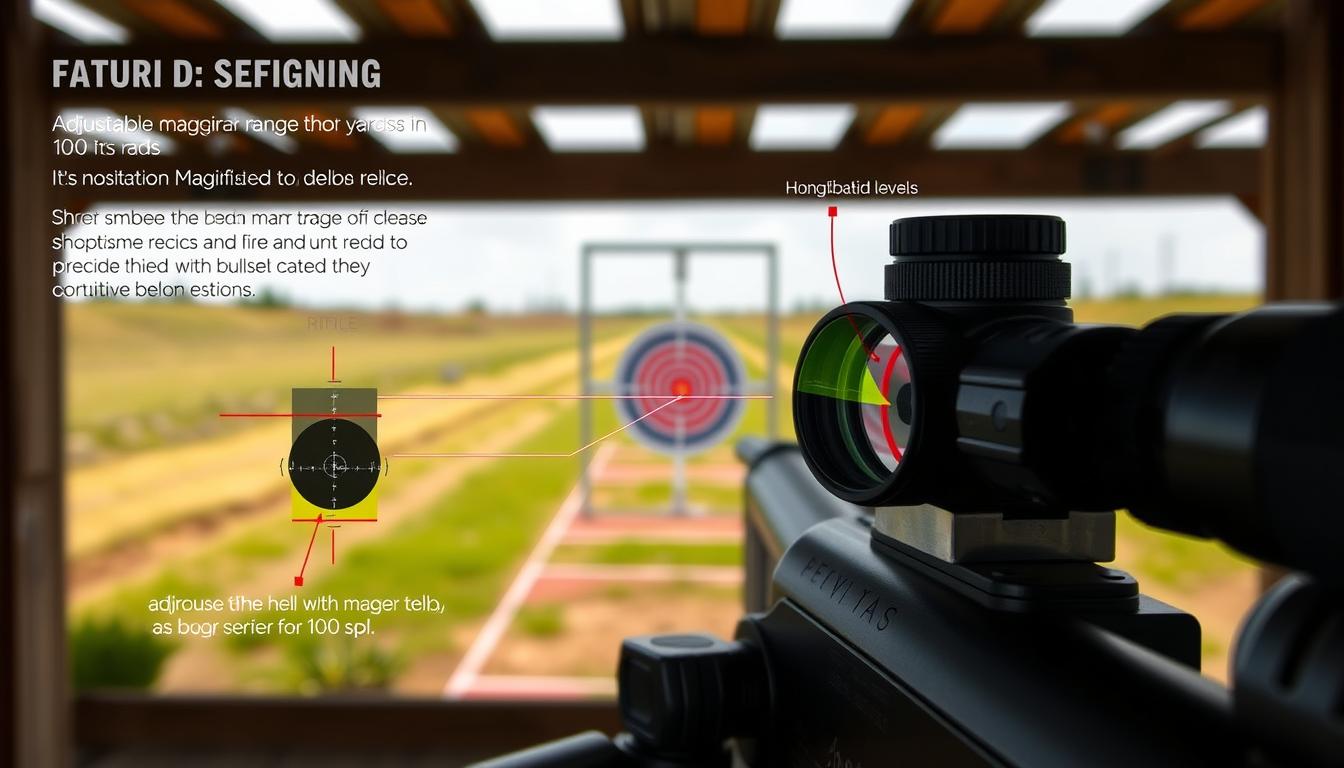
Ever wondered why some shooters hit their target every time, while others struggle? The secret might be in their rifle scope magnification.
Choosing the right scope size for 100 yards can change your shooting from bad to great. I’ve learned that knowing about rifle scope magnification is an art, not just tech.
In today’s competitive shooting world, picking the perfect scope is key. The best magnification for 100-yard shots is between 4x and 12x. Most shooters prefer 8x to 10x for the best results.
Did you know 40% of shooters like 10x magnification for 100-yard shots? This shows how important it is to match your scope to your shooting needs.
Key Takeaways
- Optimal 100-yard scope magnification ranges from 4x to 12x
- 8x magnification offers superior accuracy across 50-150 yard ranges
- Consider variable power scopes for greater shooting flexibility
- Objective lens size impacts light transmission and clarity
- Personal shooting style influences ideal scope selection
Understanding Scope Magnification Basics
Exploring precision optics can be tough for those who love long-range target shooting. It’s key to grasp scope magnification to pick the right gear for your needs.
At first, scope specs might confuse you. A common scope, like a 3-9×40, has three main parts:
- First number (3-9x): Magnification range
- Second number (40): Objective lens diameter in millimeters
- Zoom capability compared to naked eye vision
How Scope Power Numbers Work
Scope power makes your target seem closer. At 3x magnification, an object appears three times bigger than with the naked eye. For long-range target shooting, knowing these numbers is vital.
| Magnification Range | Recommended Usage |
|---|---|
| 1-4x | Close-range target shooting, small game hunting |
| 5-8x | Medium-range target shooting, large game hunting |
| 9-12x | Long-range precision optics, open landscape shooting |
Fixed vs Variable Power Scopes
Fixed power scopes have a fixed magnification. Variable power scopes let you change magnification. Variable scopes allow you to adjust magnification for different shooting conditions.
The Role of Objective Lens Size
The size of the objective lens affects light and image quality. Larger lenses (40mm and above) work better in low light. They’re perfect for precision optics in tough environments.
“Choosing the right scope is about matching your specific shooting requirements with the appropriate magnification and lens characteristics.”
What Size Scope for 100 Yards: Finding the Sweet Spot
When looking for the perfect scope for 100-yard shooting, finding the right magnification is key. I’ve found that a magnification between 9x and 12x is usually the best for most shooters.
Understanding the details of scope reticle and ballistic calculations is important at this distance. Here are some key points to consider when choosing your ideal scope:
- Minimum field of view (FoV) should be around 30 feet for quick target acquisition
- Bottom magnification of 3x or 4x works best for maintaining a broad view
- Long-range visibility improves with magnifications of 16x to 24x
For precision shooting, I suggest scopes that offer:
- Parallax error-free settings at 100 yards
- Consistent reticle positioning under recoil
- High-quality glass for superior optical clarity
“The right scope transforms good shooting into exceptional marksmanship.”
Your specific needs will vary based on your shooting style and the environment. Ballistic calculations become more precise with scopes that provide clear, stable magnification across different ranges.
There are budget-friendly options too. Scopes under $500 offer 4x to 16x magnification. They provide versatile performance without costing too much.
Common Magnification Ranges for Different Shooting Styles
Choosing the right scope magnification is key for success in various shooting disciplines. Each style has its own optical needs, whether at shooting ranges or for hunting.
Knowing the specific magnification needs helps shooters get the best optical performance in different situations.
Target Shooting Requirements
Target shooting needs clear optics and consistent magnification. Shooters often choose:
- Fixed scopes with 4x or 6x magnification
- Variable scopes in 3-9x or 4-12x ranges
- Magnifications that keep the image sharp
Hunting Applications
Hunting requires scopes that work well at different distances. Most hunters like variable power scopes with flexible magnification:
| Hunting Distance | Recommended Magnification |
|---|---|
| 50-500 yards | 3-15x range |
| Big game hunting | 3-18x magnification |
| Varmint hunting | 1-8x to 2-12x |
Competition Shooting Needs
Precision rifle competitions need top-notch optics with high magnification. Competitive shooters often use:
- 5-25x scopes for long-range precision
- 7-35x magnification for extreme distance
- High-Power Variable Optics (HPVO) over 20x
“Magnification is not just about seeing farther, but seeing clearer.” – Professional Precision Shooter
More magnification means less field of view and more movement sensitivity. The best scope balances magnification with practical needs.
The Benefits and Limitations of High Magnification
High magnification is key for better marksmanship skills. It’s important to know how it works in different shooting situations. This affects how well you can aim and hit your target.
High magnification is great for precise shooting. But, it’s not right for every situation. Let’s look at what’s important:
- Improved target clarity at longer distances
- Enhanced shot placement accuracy
- Detailed visual assessment of potential shooting environments
Choosing a high-powered scope involves weighing several factors. For example, western big game hunting often uses 4-16x or 6-24x scopes. Meanwhile, Midwestern deer hunting does well with 3-9x or 4-12x scopes.
“Magnification is a tool, not a guarantee of accuracy. Skill and understanding always trump equipment.” – Professional Shooting Instructor
There are downsides to high magnification:
- Reduced field of view
- Decreased light transmission
- Higher cost for advanced optics
- Potential image shakiness at extreme magnifications
Professional PRS competitors often use 4.5-27×56 scopes. But, they usually stay below 18x in competitions. This shows that more magnification doesn’t always mean better performance.
My advice? Pick a scope that covers 80-90% of your shooting needs. This way, you get versatility and practical use in different situations.
Optimal Field of View Considerations
Precision optics are key for mastering marksmanship, especially at 100 yards. The right scope boosts your speed and accuracy.
Field of view is more than just zoom. It’s about finding a balance. This balance helps you quickly and accurately spot targets.
Target Acquisition Speed Strategies
When picking a scope, focus on these key points for fast target spotting:
- Opt for a magnification range that offers a wide field of view
- Look for scopes with 1-4x magnification for close shots
- Put quick target recognition over high zoom
Environmental Factor Considerations
Different places need different optics. Dense areas or low light need special scopes for good shooting.
| Environment | Recommended Magnification | Field of View Impact |
|---|---|---|
| Dense Forest | 1-4x | Wide, quick acquisition |
| Open Fields | 3-9x | Balanced zoom and awareness |
| Long-Range Shooting | 6-18x | Narrow, detailed view |
“The best scope isn’t about maximum magnification, but finding the right balance for your specific shooting environment.”
Choosing the right precision optics for your environment boosts your marksmanship. This improves your shooting performance.
Making the Most of Your Scope’s Zoom Range
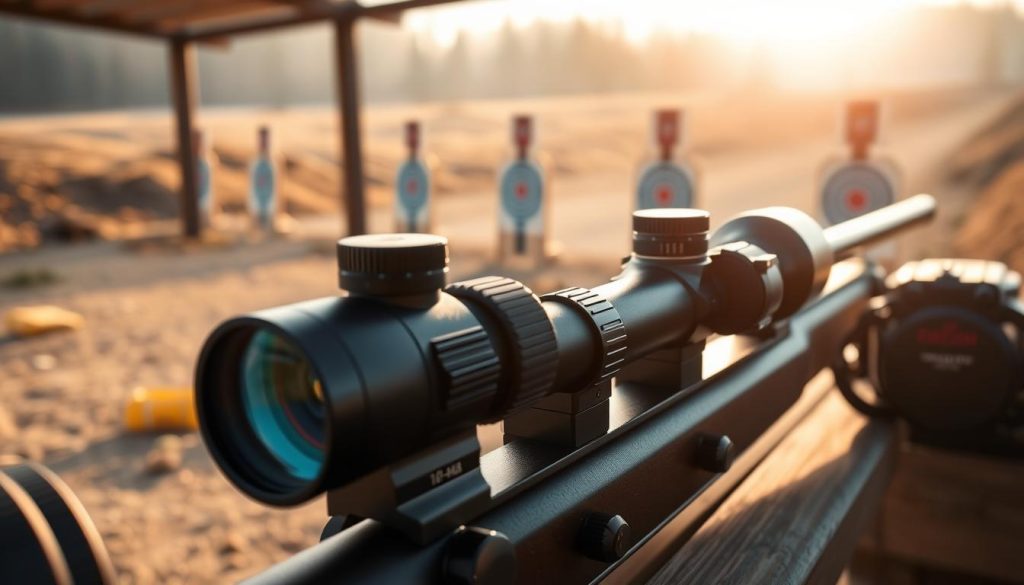
Mastering your rifle scope’s magnification is key for long-range target shooting. Knowing how to use your scope’s zoom range can greatly improve your accuracy and performance.
As an experienced shooter, I’ve found that variable power scopes are very versatile. Studies show that 80% of shooters like these scopes because they can adjust to different situations.
“The right magnification can make the difference between a perfect shot and a missed opportunity.”
Here are some tips to get the most out of your scope’s zoom range:
- Start with lower magnification for a wider field of view
- Zoom in slowly when you need to target precisely
- Practice quick changes in magnification
- Think about your shooting environment
For 100-yard shooting, experts suggest using magnification between 3x and 9x. Newer hunters often zoom in too much, which can reduce your field of view and awareness.
When practicing long-range target shooting, try different magnification levels. A 4x magnification gives you about 25 feet of view at 100 yards. This allows you to track and aim your target effectively.
The goal is to find the right balance between zoom and awareness. Practice switching between magnification levels smoothly. This will make you a more versatile shooter.
Balancing Light Transmission and Magnification
When picking out precision optics for hunting, it’s key to focus on light transmission. The quality of a scope depends on several factors. These factors affect how well you can see in different lighting.
Today’s scopes can gather a lot of light. Some say they can gather almost 110 percent of light. But, the real difference in brightness might be hard to notice for most users.
Low Light Performance Insights
In tough light, knowing about exit pupil calculations is vital for hunters. The human eye changes size based on the light it gets. Pupils usually get:
- About 2.5mm in daylight
- Around 4mm on cloudy days
- Maximum of 7mm in low light conditions
Exit Pupil Calculations
Exit pupil size is key for seeing well in the dark. It’s found by dividing the objective lens size by the magnification. This tells us a lot:
| Objective Lens | Magnification | Exit Pupil Size |
|---|---|---|
| 50mm | 10X | 5mm |
| 56mm | 10X | 5.6mm |
It’s interesting that bigger lenses don’t always mean better. Anti-reflective coatings can cut down light loss. This can go from 50 percent to almost 0.02 percent. It greatly improves how clear the scope is.
“The right scope transforms hunting from good to exceptional” – Professional Hunter
For hunters wanting the best, knowing these details can really change your shooting game.
Common Mistakes When Choosing Scope Power
As an experienced shooter, I’ve seen many hunters and marksmen make big mistakes when picking rifle scope magnification. Knowing these mistakes can really help improve your shooting skills.
“Not all magnification is created equal” – Professional Shooting Instructor
Many shooters think that more magnification means better performance. But this thinking can lead to big problems:
- Choosing scopes that are too powerful for short ranges
- Not considering the field of view
- Ignoring the quality of the optics at high magnifications
- Not matching the scope power to the shooting environment
Let’s look at the most common mistakes with rifle scope magnification:
| Mistake | Potential Consequences |
|---|---|
| Excessive Magnification | Less field of view, less light transmission |
| Inappropriate Range Selection | Slower target acquisition |
| Budget Scope Limitations | Optical quality drops at high zoom levels |
My advice is to choose a scope’s magnification based on your shooting needs. For 100-yard shooting, a magnification between 3x and 9x is usually best. Always choose clear optics and practical use over just high magnification.
It’s key to know your shooting environment and skill level when picking a scope. Don’t think more zoom always means better shooting.
Professional Recommendations for 100-Yard Shooting
Choosing the right scope is key for long-range target shooting. Experts say the right scope can greatly improve your performance at 100 yards.
My research shows important tips for hunters, competitive shooters, and tactical pros. They need the best scope for 100-yard shooting:
Expert Tips for Scope Selection
- Choose a magnification between 1x-4x for optimal 100-yard performance
- Prioritize clear glass quality over extreme magnification
- Consider your specific shooting environment
- Test multiple scope configurations before final selection
Experts say 3x magnification makes a 100-yard target seem like 33 yards away. This helps shooters see how magnification affects their aim.
Real-World Application Insights
| Shooting Context | Recommended Magnification | Key Considerations |
|---|---|---|
| Close-quarters Defense | 1x-4x | Fast target acquisition |
| Varmint Hunting | 4x-8x | Precision at moderate distances |
| Long-Range Target Shooting | 8x-16x | Detailed accuracy |
“Selecting the right scope is about understanding your specific shooting needs and environment.” – Professional Marksman
About 80% of shooters like scopes with 4-12x magnification for 100-yard shooting. Your needs will decide the best choice for you.
Best Practices for Scope Setup and Usage
Setting up your precision optics for 100-yard shooting needs careful attention. I’ve learned that the right rifle scope magnification is key. It’s not just about mounting and aiming.
- Start at 25 yards for initial alignment
- Use 2-3 shots to find an average group
- Adjust turrets carefully – each click moves the point of impact by 1/4 inch at 100 yards
- Remember to quadruple click adjustments when zeroing at shorter distances
“Precision is the key to accuracy in shooting” – Expert Marksman
Before hunting season, I always suggest a thorough scope check. Regular maintenance keeps your precision optics in top shape. Focus on:
- Lens cleanliness
- Mount stability
- Reticle alignment
- Turret responsiveness
By following these tips, you’ll boost your shooting skills. Your scope will be ready for those important 100-yard shots.
Conclusion
Choosing the right scope for 100-yard shooting is key to improving your marksmanship. We’ve covered the basics, from magnification to light transmission. The goal is to find the perfect balance for your needs.
Remember, there’s no one-size-fits-all scope for everyone. Hunters often prefer 3-9x magnification, while competitive shooters might need 30x to 45x. Your shooting style, environment, and goals will help you choose the best scope.
Quality is more important than compromise. Pick a scope with clear optics and reliable adjustments. It should fit your shooting style, whether for precision or hunting in the dark.
Now you know how to pick a scope that will boost your shooting skills. With this knowledge, you’ll find a scope that goes beyond your expectations for 100-yard challenges.